People use three terms for the same corner of a building: structured cabling, low voltage and "running some Cat6". They overlap, but they are not the same thing. One describes how a cabling system is designed. One describes a trade category. One describes a single task. Mixing them up leads to quotes that cannot be compared and to confusion about who is allowed to do the work.
This article explains the difference between structured and unstructured (point-to-point) cabling, where low voltage fits, and why the license question has no single answer. It is general information, not legal advice. Rules differ by country, state and sometimes city, and by job type, so confirm the details with the local authority and with your contractor.
What is structured cabling?
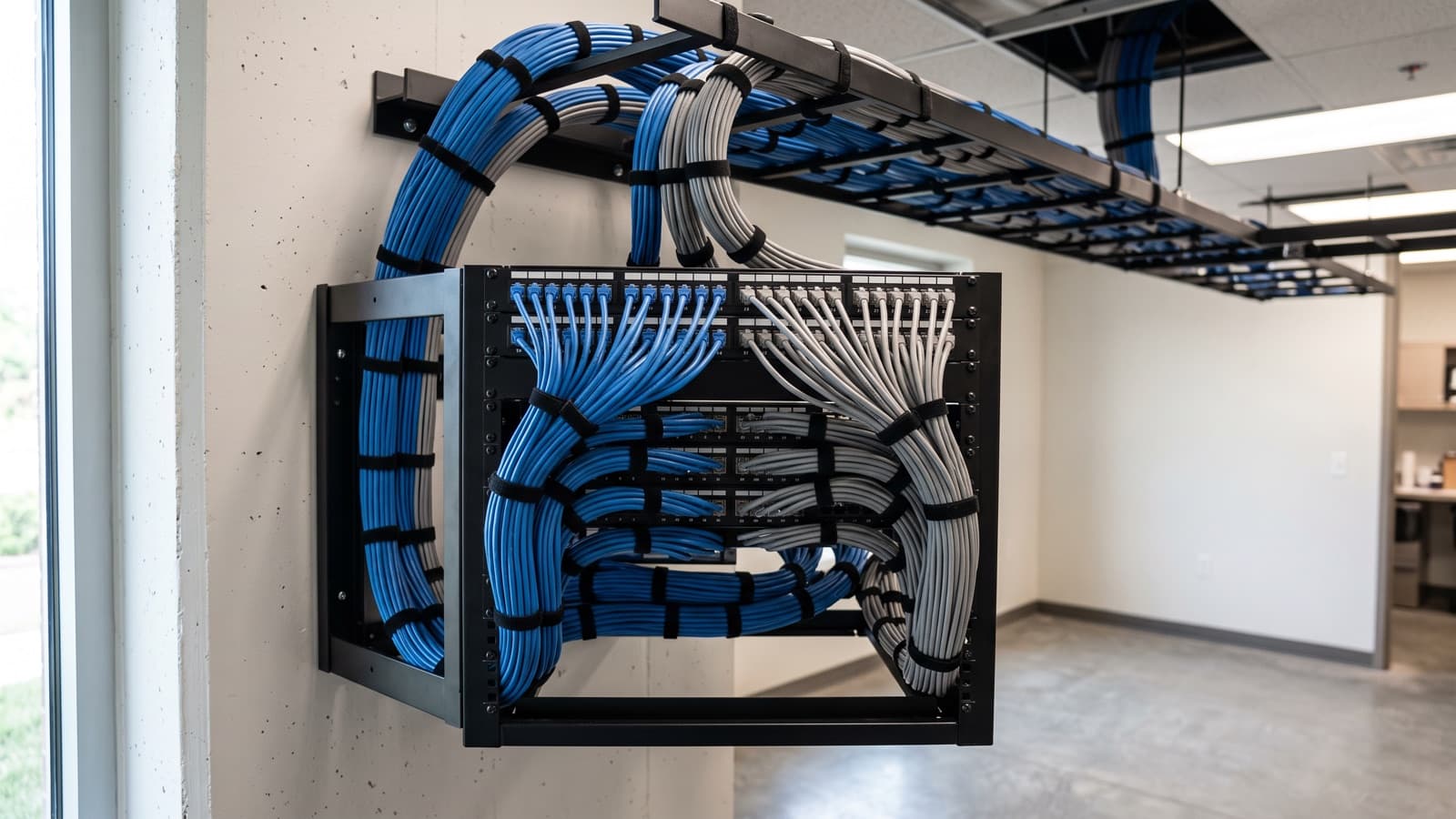
Structured cabling is a planned, standards-based cabling system in which every outlet is cabled back to a central patch panel, and every change is made at that panel instead of in the walls.
The TIA standards divide such a system into subsystems. CablingInstall describes six: the entrance facility where outside cabling meets the building, the equipment room, backbone cabling, the telecommunications room, horizontal cabling and the work area. Horizontal cabling runs from the work area outlet to the telecommunications room, and the same article gives a 90 meter maximum for it regardless of media type.
The point of the design is flexibility. The same article says that when the infrastructure is properly installed, labeled and recorded, it allows adds, moves and changes to be made without starting again. Our glossary entry on structured cabling gives the short definition.
What is unstructured or point-to-point cabling?
Unstructured cabling, often called point-to-point cabling, is a set of individual cables run straight from one device to another with no patch panel or planned pathway in between.
It grows one request at a time. A cable goes from a switch to a desk, another goes to a printer, a third goes to a camera. Each run is short and cheap to describe, which is why it is common in small offices and in quick fixes. The trouble shows up later. Cables are often unlabeled, they cross each other, and nobody has a record of what connects to what.
Point-to-point is not always wrong. A single cable between two fixed devices, such as a camera and a nearby switch, can be a fair choice. It becomes a problem when it is used as the whole building plan.
How do structured and point-to-point cabling compare?
Structured cabling trades more planning up front for easier changes, clearer records and simpler troubleshooting later.
The table summarizes the usual differences. Your site may sit between the two columns.
| Topic | Structured | Point-to-point |
|---|---|---|
| Design | Planned pathways and a telecommunications room | Runs added as needed |
| Termination | Outlet to patch panel, then patch cords to switches | Device to device, often direct |
| Moves and changes | Done at the panel with a patch cord | Often needs a new cable pulled |
| Labels and records | Labeled and recorded as a deliverable | Often missing or out of date |
| Testing | Each permanent link tested to a standard limit | Often tested only by plugging in |
| Best fit | Offices, floors and sites expected to change | A few fixed devices close together |
What does "low voltage" mean, and how does structured cabling relate to it?
Low voltage is a trade label for wiring that carries signals or limited power instead of mains power, and structured cabling is one kind of low voltage work.
The label covers data cabling, voice, security cameras, access control, alarms, audio visual and similar systems. Code books do not treat it as one neat category. In the US National Electrical Code, different articles cover different systems. SDM Magazine lists Article 725 for remote control and power-limited circuits such as intercom and access control, Article 760 for fire alarm circuits and Article 800 for communication circuits such as LANs. It also notes the NEC does not formally define the term low voltage. Article numbers and wording change between editions, so check the one your area has adopted.
Power over Ethernet is one reason the label is loose. A single Cat6 cable can now carry data and power to a camera or phone, so a data job can touch several systems at once. Say what the cable will feed when you write the scope.
Do you need a license to run Cat6 cable?
It depends on where the work is, who does it and what the job involves, so there is no honest one-line answer.
Some places require a contractor license or registration for low voltage or communications work. Some have no separate license for it. Some tie the rule to the type of job, such as new construction, work inside walls or ceilings, or work that needs a permit. A city or county can add its own rules on top of state or national ones. Rules for a building owner doing work in their own premises can also differ from the rules for a contractor working for others.
We do not name licenses or laws here, because they change and a wrong answer could cost you a failed inspection. To get a reliable answer, ask the local building or permitting office, or the body that licenses contractors in your area, whether your specific job needs a license or a permit. Then ask your contractor to show you what they hold for that location.
- Where is the building (country, state or province, city)?
- Is it new construction, a renovation or a small add-on?
- Will cable run through walls, ceilings, risers or shared spaces?
- Does any of it feed fire, life safety or security systems?
- Is the person doing the work an employee, an owner or a contractor?
Which code points can apply to a Cat6 job?
Beyond licensing, a Cat6 job can be affected by cable fire ratings, fire-stopping, pathway rules and permits, and the inspector for your area decides how they apply.
In the US the person who interprets and enforces the code is called the authority having jurisdiction, and it can be a building official, fire marshal or inspector depending on the place. SDM Magazine notes that jobs are often inspected and that an inspector who finds the wrong cable type can require its removal. The practical points to raise with your contractor are:
- Cable jacket rating: cable used in air handling spaces or between floors usually needs a suitable fire rating, and the right one depends on the space and the local code.
- Fire-stopping: a cable that passes through a fire-rated wall or floor usually needs the opening sealed with an approved method.
- Pathways and separation: the code can limit how data cable shares a route with power wiring.
- Permits and inspection: some jobs need a permit before work starts and an inspection after.
- Documentation: labels, as-built drawings and test results help at inspection and later.
How should you scope a cabling job so it is done properly?
Write down the standard to build to, the pathways, the labeling scheme and the test results you expect, and ask the contractor to confirm the local requirements in writing.
A good scope for structured cabling usually covers the following steps.
- Survey the site and list the outlets, the rooms and the systems each cable will feed.
- Choose the cable category, jacket rating and pathways to suit the spaces involved.
- Agree the labeling scheme and the telecommunications room layout before work starts.
- Ask who handles permits, fire-stopping and inspection, and who is licensed where required.
- Test each permanent link to a named limit. Fluke Networks calls the permanent link the fixed portion of the channel, from the panel to the outlet, and prefers it for acceptance testing because good patch cords can make a channel pass when the link has failed.
- Receive labels, as-built drawings and the test report as deliverables.
How can Deploris help with structured cabling?
Deploris can survey a site, scope structured cabling and low voltage work in writing, install and label it, and hand over test results and as-built records.
We agree the standard, pathways, labeling and testing before work starts, and we ask you to confirm local license and permit requirements with the local authority for your site. Scope is agreed first and pricing is quoted against it after a survey. Our patch panel and rack cabling and cabling certification services cover the telecommunications room end and the proof of performance.
Key takeaways
- Structured cabling is a planned system built around patch panels and labeled links. Point-to-point cabling is a set of direct runs without that plan.
- Low voltage is a trade label covering data, voice, security and similar systems. Structured cabling is one part of it.
- License and permit rules for running Cat6 depend on location, job type and who does the work. Check with the local authority and your contractor.
- Raise cable ratings, fire-stopping, permits and test results in the scope, not after the cable is in the ceiling.
Sources and further reading
- CablingInstall, Know the 6 subsystems of a structured cabling system (opens in a new tab)
- CablingInstall, Structured cabling: the inside story (opens in a new tab)
- SDM Magazine, What technicians need to know about cable and the NEC (opens in a new tab)
- Fluke Networks, Channel, permanent link and patch cords (opens in a new tab)