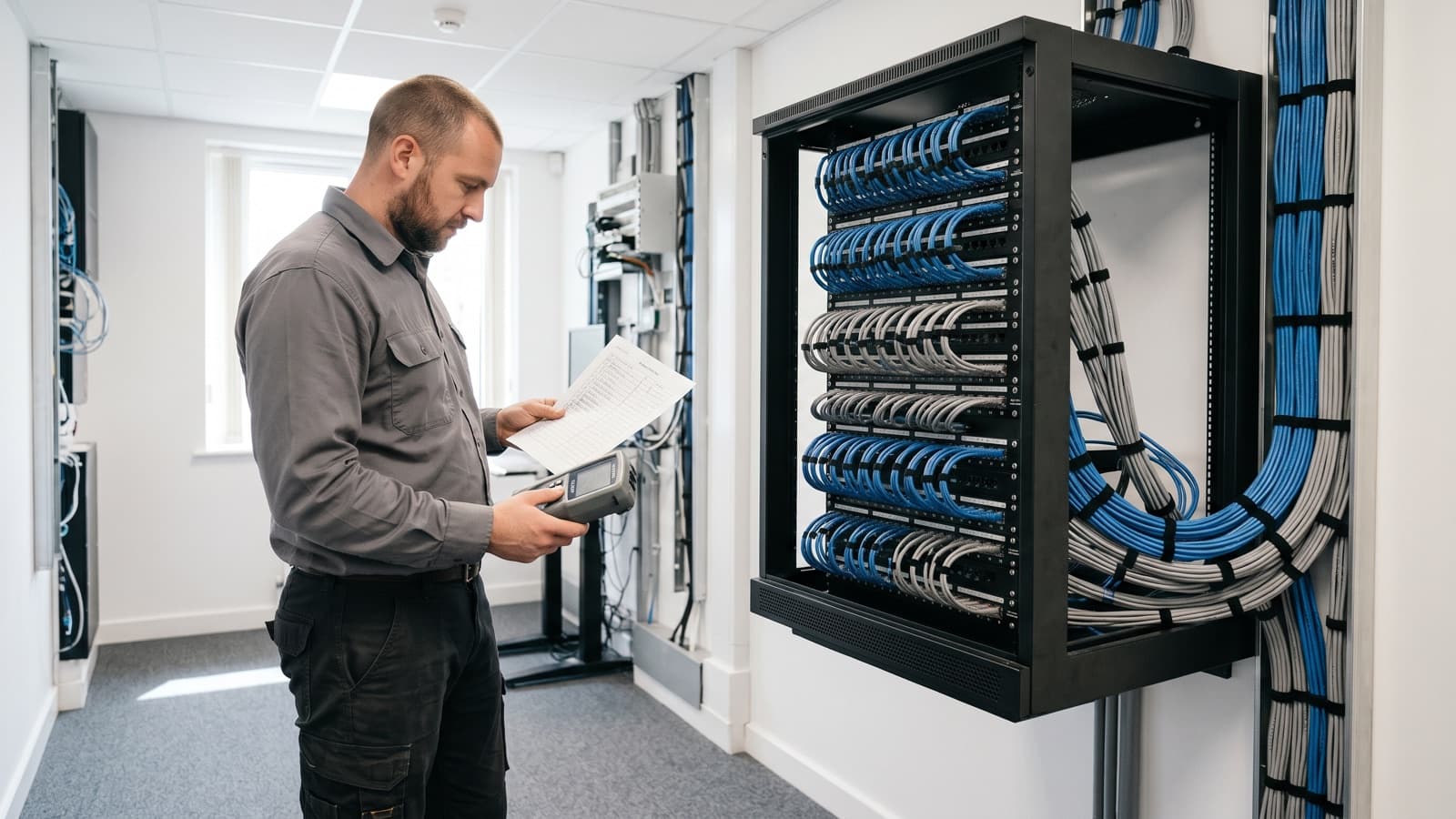
Most search results for a structured cabling company are lists of vendors. A list tells you who exists, not how to judge a quote. Two quotes for the same building can describe very different jobs: one with testing, labels and drawings, the other with only cable and labor.
This guide is a buyer's checklist. It does not rank or review any company. It covers what to decide before you ask for quotes, how to compare the ones you get, and what to ask for before you sign. Rules on licensing, permits and fire codes vary by location, so check them with the building owner and the local authority.
What should I decide before I ask for quotes?
Decide the scope first, because contractors can only quote what you describe, and vague requests produce quotes that cannot be compared.
You need a short written brief, not cabling expertise. Our articles on structured versus unstructured cabling and on fiber versus copper cover the basics.
- Scope: which floors, rooms and outlets, plus any racks, panels or cabinets to be installed or cleaned up.
- Number of drops and where they go, ideally on a floor plan or a simple spreadsheet.
- Cable category for copper, such as Cat6 or Cat6A, and fiber type and strand count for any backbone runs.
- Standards to follow and edition, and whether you want permanent link or channel testing.
- Pathways: existing conduit, cable tray or ceiling space, or new pathways that must be built.
- Timing: target dates, working hours, and any dates when the building cannot be disturbed.
What should a good cabling quote contain?
A good quote lists what is included in plain terms: materials, labor, testing, labeling, documentation and warranty, tied to your written scope.
A single lump sum with no breakdown is hard to check. You should see that every item in your brief is covered, what is excluded, and what is assumed, such as ceiling access or working hours. Our cost per drop article explains why scope drives the number.
- Your scope restated: drop count, locations, cable type and standard.
- Labor and project management, including who supervises on site.
- Testing method, tester type and what percent of links are tested.
- Labeling scheme, as-built drawings and the format of deliverables.
- Warranty terms: what is covered, for how long, and who issues it.
- Assumptions, exclusions and how changes to scope are handled.
How do I compare cabling quotes line by line?
Put the quotes side by side and compare them on the same rows, then ask every bidder to fill the gaps before you look at the totals.
A cheaper quote that leaves out testing or drawings is a smaller job, not a cheaper one. Add rows from your own brief.
| Line item | What to look for | Question to ask |
|---|---|---|
| Cable and standard | Named category or fiber type and the standard it meets | Which category and standard edition are you quoting? |
| Drop count | Same number and locations as your brief | Does the count include spares and any uncounted outlets? |
| Pathways | Existing versus new, and who supplies supports | What is assumed about ceiling access and cable routes? |
| Testing | Method, limit and share of links tested | Are all links tested, and to which limit? |
| Documentation | Test files, labels, as-built drawings | What exactly will I receive at handover? |
| Warranty | Scope, duration and issuer | Is a manufacturer warranty included, and what does it require? |
| Exclusions | A written list | What would cause a change order? |
How should testing and documentation be specified?
Specify testing and documentation as deliverables in the scope, because installers produce what the contract names and little else.
Fluke Networks describes certification as checking each link against a cable category or class and returning a Pass or Fail, with test data stored for later inspection. Qualification only checks whether the cabling can support an application, and it does not confirm compliance with a standard. Ask which one "tested" means in a quote. Fluke Networks also favors permanent link testing for proving installed cabling, because a channel test can pass with good patch cords even when the fixed cable has failed.
Write down the standard, the link type, the share of links tested and the file formats. Our article on cable test reports lists what a report should show.
What should labeling, as-built drawings and records look like?
Labels, as-built drawings and a cable schedule should let someone who has never seen the building trace any cable from the outlet to the patch panel port.
Agree the labeling scheme before installation begins, so that outlet labels, panel labels and test result names all match. As-built drawings should show actual outlet locations, not the original plan, and a cable schedule should map each link ID to its outlet, port and test result. TIA publishes an administration standard, ANSI/TIA-606-C, for telecommunications infrastructure in buildings and campuses. If you want a recognized scheme, ask the contractor which administration approach they follow.
Ask when you will receive the records, and tie final payment to handover where your procurement rules allow.
What do cabling warranty programs require?
A manufacturer's cabling warranty usually requires that a certified or accredited installer put in the manufacturer's products, test the links and register the system.
Programs differ, so read the actual terms. One manufacturer's public warranty page, for example, says the installer must be accredited by that manufacturer, the installed system must be registered and validated before a certificate is issued, and later adds, moves and changes can be registered as well. It also says the warranty does not cover improper installation. Fluke Networks says certification is almost always required for manufacturer warranty support.
So ask three things. Is the contractor currently authorized by the manufacturer you want? Who files the registration, and when? What evidence does the program need from the test files?
What should I ask about site access, working hours and building rules?
Ask how the crew will work in your building, because access, hours and building rules affect the schedule as much as the cable does.
Many buildings have rules set by the landlord or property manager, such as loading dock times, elevator use, after-hours work and insurance paperwork. Firestopping of penetrations through fire-rated walls depends on the building and the local authority, so ask how the contractor handles it and who signs it off. Do not assume it is covered unless the quote says so.
- Which building rules and approvals does the quote assume, and who obtains them?
- How are firestopping and penetrations handled and documented?
- What do you need from us: access, power, keys, escorts, a staging area?
How do I check references and past work?
Ask for projects similar in size and type to yours, and speak to the people who ran them, because a good reference for a different kind of job tells you little.
A trade article on selecting a contractor advises looking at documented track record, checking that certified staff are on the contractor's payroll and will work on your project, and asking for resumes of the project manager and field lead. It also warns that strong office management does not help if the field technicians are inexperienced.
- Two or three similar projects, with a contact to call.
- A sample test report and a sample as-built package, with client details removed.
- The name and background of the project lead and the on-site lead.
- Current manufacturer authorizations, if you want a manufacturer warranty.
- Whether subcontractors will do any of the work.
What are the red flags, and what is the one-page checklist?
The main red flags are a quote with no scope, no testing, no named standard or no handover documents, and anything that pressures you to sign before the scope is clear.
Also watch for lump sums that cannot be broken down, unclear answers about who does the work, and warranty promises that are not in writing. Use the list below as a one-page checklist. Deploris scopes structured cabling work in writing first, can test cabling to a named standard, and delivers test files and records as agreed. Availability and details are confirmed when the work is scoped.
- Write the scope: locations, drops, cable type, standard, pathways, timing.
- Send the same brief to every bidder and ask for a line-by-line quote.
- Confirm what "tested" means, the limit used and that all links are covered.
- Agree labeling, as-built drawings and a cable schedule up front.
- Ask what the warranty requires and who registers it.
- Confirm site access, hours, firestopping and building rules.
- Speak to references for similar projects and see sample reports.
- Name the project lead and the on-site supervisor in the contract.
- Write the handover package and its date into the agreement.
Key takeaways
- Write the scope before you ask for quotes: drops, cable type, standard, pathways and timing.
- Compare quotes line by line. A quote without testing, labels or drawings is a smaller job, not a cheaper one.
- Specify testing and handover documents as deliverables, with all links tested to a named limit.
- Ask what a warranty requires and who registers it, and check references on similar projects.
Sources and further reading
- Fluke Networks, Certification vs. qualification: a closer look (opens in a new tab)
- Fluke Networks, Channel, permanent link and patch cords (opens in a new tab)
- Lightwave, Selecting the right contractor (opens in a new tab)
- Panduit, Certification Plus System Warranty (example of a manufacturer warranty program) (opens in a new tab)
- TIA, ANSI/TIA-606-C administration standard announcement (opens in a new tab)